From Calling Cards to Matchmaking Profiles
Calling cards to matchmaking profiles trace how introductions changed. Learn how the setting shapes what a description should say and what it leaves unsaid.
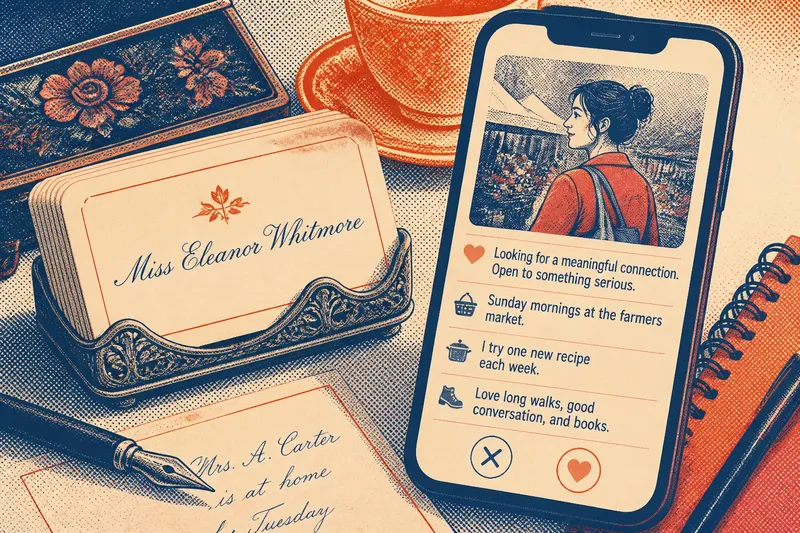
Calling cards and matchmaking profiles make introductions in different ways. In nineteenth-century Britain and the United States, calling cards commonly identified a visitor by name and sometimes by title; local etiquette shaped how they were presented or left. A profile, by contrast, must make its writer legible to people who may have no shared acquaintance.
The difference is not simply old paper versus a screen. A card belonged to a social ritual with rules understood by its participants. A profile is usually read without that surrounding knowledge, so it has to supply more of its own context.
Calling cards belonged to a particular social ritual
In some nineteenth-century British and American social circles, calling cards were used during visits and introductions. Their conventions varied by place, period, and social group, so there was no single universal rulebook. A card could identify its bearer and signal a visit; it was not a miniature biography.
That narrow purpose mattered. The recipient could place the card within a network of households, acquaintances, and expected visits. The object carried a name, while the social setting supplied much of the meaning.
A modern personal introduction can work similarly when a trusted friend knows both people. “You should meet Mara; she organizes the neighborhood book exchange” gives a reason to talk and identifies who is making the connection. A long list of flattering qualities would add bulk without clarifying the invitation.
Profiles must explain more to people without shared context
A matchmaking profile is often read by someone who cannot ask a mutual acquaintance for background. It therefore needs to make intentions and everyday preferences understandable in the writer’s own words.
Concrete details help. “I spend Sunday mornings at the farmers market and try one new recipe each week” gives a reader something to ask about. “I am adventurous and authentic” offers conclusions without showing what those claims mean in ordinary life.
Say you are writing a profile for a service where readers cannot ask your friend what you are like. You start with “I love adventure,” then replace it with “On weekends I usually visit a farmers market, then try a new recipe at home.” The resulting description gives a stranger two specific openings for conversation, while avoiding a claim that could mean almost anything.
Choose details according to who will read them
The setting changes what a description needs to do. A friend introducing two people can explain the connection aloud; a profile has to stand on its own; a family-mediated introduction may carry expectations that neither person chose. Use these checks to decide what to clarify:
- A mutual friend knows both people: Check whether the friend can explain why the introduction came up. If they can, keep the description brief and let that reason guide the meeting; if they cannot, ask for the context before agreeing.
- The reader is a stranger: Check whether your profile states the kind of connection you seek. If it does, keep the wording; if it does not, add a direct sentence about your intentions rather than relying on adjectives.
- Family or community expectations are involved: Check which preferences are yours and which belong to other people. If they are clear, state your own priorities plainly; if they are mixed together, ask the introducer to separate them before arranging a meeting.
- The meeting will be formal or public: Check whether the description suits that setting. If it does, keep private topics for later conversation; if it does not, revise it to focus on the reason for the introduction and the relevant expectations.
- You do not know what the other person was told: Check with the introducer about what they shared. If both received the same basic account, proceed with fewer assumptions; if not, ask for a clarification before treating the description as a promise.
- A profile feels polished but vague: Check for a detail that can be discussed, such as a hobby or a preferred way to spend free time. If one appears, ask about it; if none does, request more context or decide that the profile gives you too little basis to proceed.
These checks do not prescribe etiquette for every community. They help identify where the description gets its authority: from a mutual acquaintance, from the writer, or from a social setting with its own expectations.
How should a description work before a meeting?
What belongs in a matchmaking profile?
Include your intentions, a few meaningful preferences, and details that show how you spend your time. Keep information that feels private or irrelevant for a conversation with enough context.
Do photographs replace written descriptions?
No. A photograph offers a visual impression, while text can explain interests and intentions. Neither tells a reader how a conversation will unfold.
Should an introducer describe both people in the same terms?
Not necessarily; each person may have different interests and circumstances. The important point is to describe each fairly and avoid suggesting intentions either person has not expressed.
What can I do if a profile feels too polished?
Look for a concrete detail and ask about it. If the person answers in a way that gives you useful context, continue the conversation; if the profile offers no clear point of contact, ask for more information or leave the invitation unanswered.
Descriptions carry the customs of their setting
A calling card in a particular social circle depended on shared conventions. A matchmaking profile makes selection more explicit by placing preferences and self-descriptions side by side. Neither format removes judgment; each gives it a different setting and audience.
A description is like a label on a jar: useful for identification, but not a substitute for what happens when it is opened. The comparison stops there, since a person is not an object to inspect. The useful distinction is between offering orientation and pretending to settle what a meeting will reveal.
When introducing someone, separate what you know from what you assume. “She volunteers at the community garden and said she would enjoy meeting someone who likes being outdoors” reports a stated interest. “You two are perfect for each other” turns an invitation into a verdict before either person has had a say.
Matchmaking profiles now carry much of the introductory work that a shared social ritual once handled. The phrase “calling cards to matchmaking profiles” names a change in medium, but also a change in who supplies context and who has to interpret it. A useful description makes that context clear without pretending that a meeting can be decided in advance.
Leave the meeting room to surprise you
A concise account may suit an introduction made by someone who knows both people. A profile for strangers needs clear intentions and details that invite a real question. An introduction shaped by family or community benefits from distinguishing personal preferences from the expectations around them.
The best description gives someone a fair reason to approach without dictating what they should conclude. It should make the first exchange easier, not turn the people in it into finished portraits.